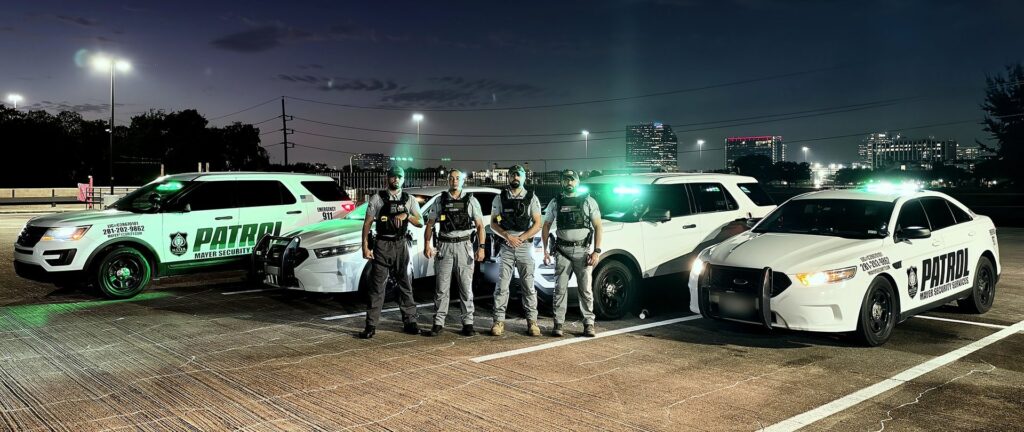
Armed Mayer Security Services officers field Agilite gear, trusted by Special Operations units worldwide, and Plix AI body cameras to protect Texas critical infrastructure.
It is almost traumatic to scroll through LinkedIn and be bamboozled by the AI generated content of my connections in the security space, from AI generated headshots to SUVs, private jets and personnel.
Where AI Helps Security, and Where It Hurts
While artificial intelligence has been a major helping hand to most of us in security, who use it to optimize our operations, from bookkeeping, report drafting and summary reviews to calendar organization, and on to more sophisticated uses in forensics, it has also caused reputational harm for some practitioners, which indirectly reflects on all of us in the industry. I can’t imagine a general counsel, a company executive or a key decision maker in their sober mind looking over a proposal and selecting a company based on its “AI slop” photos or videos.
So before anyone accuses me of being afraid of the future, further down this page I am going to show you what AI looks like when a security agency uses it to do the job instead of to dress up a brochure. It is a body camera from Plix AI, our officers wear it on post, and if you work in security yourself you may want to skip straight to it and compare notes.
So Here Is Something Radical: Things That Exist
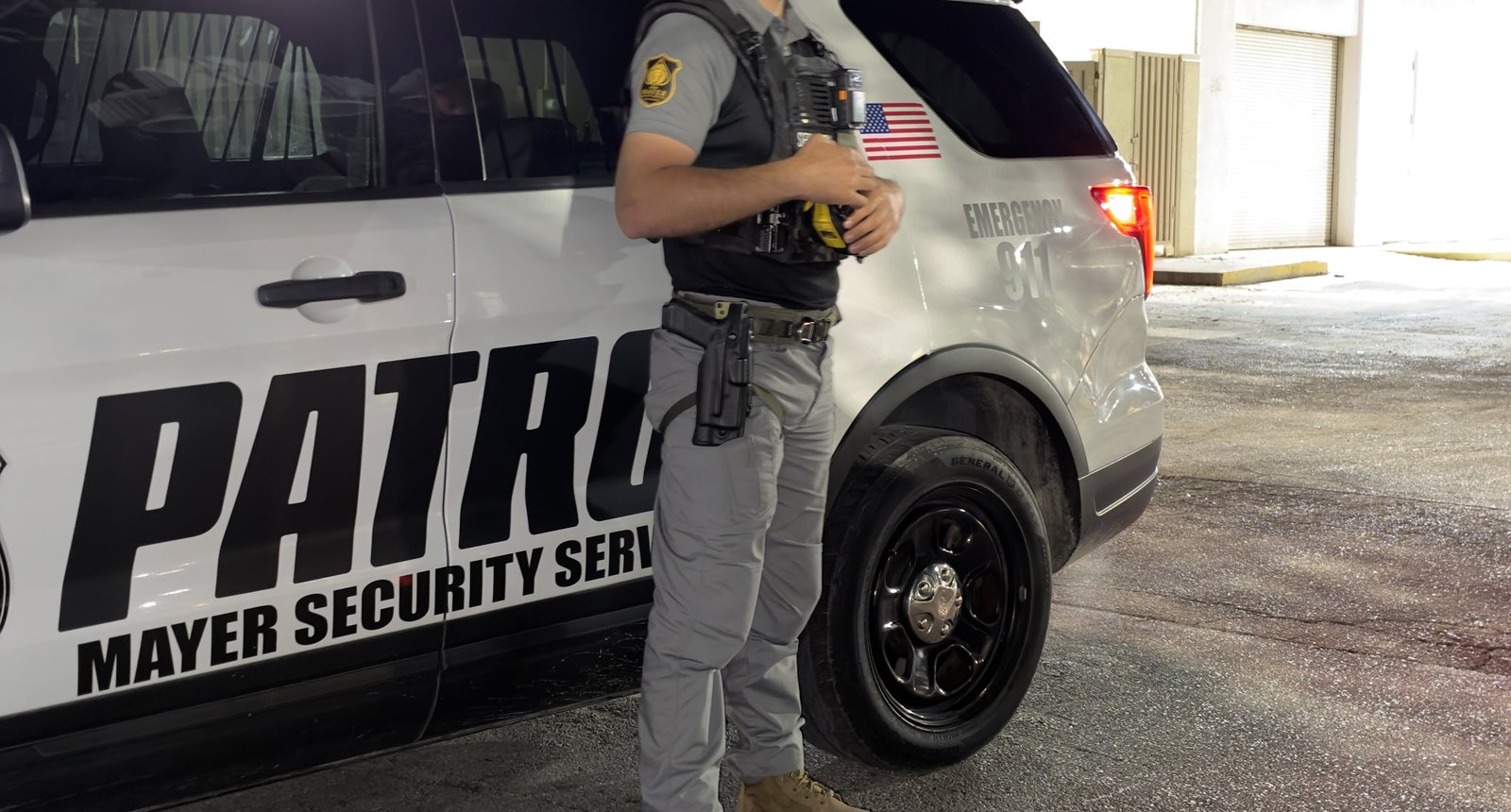
So I am going to do something radical and show you things that exist. Every photo of our people in this article was taken in Houston, with our own officers standing in front of our own patrol vehicles, wearing the gear we bought for them with real money we would frankly have enjoyed keeping. Nothing here came out of a prompt. No robot was asked to imagine a handsome man next to a jet.
If we are asking a client to trust Mayer Security Services with their people and their property, the least we can do is show them what they are actually paying for.
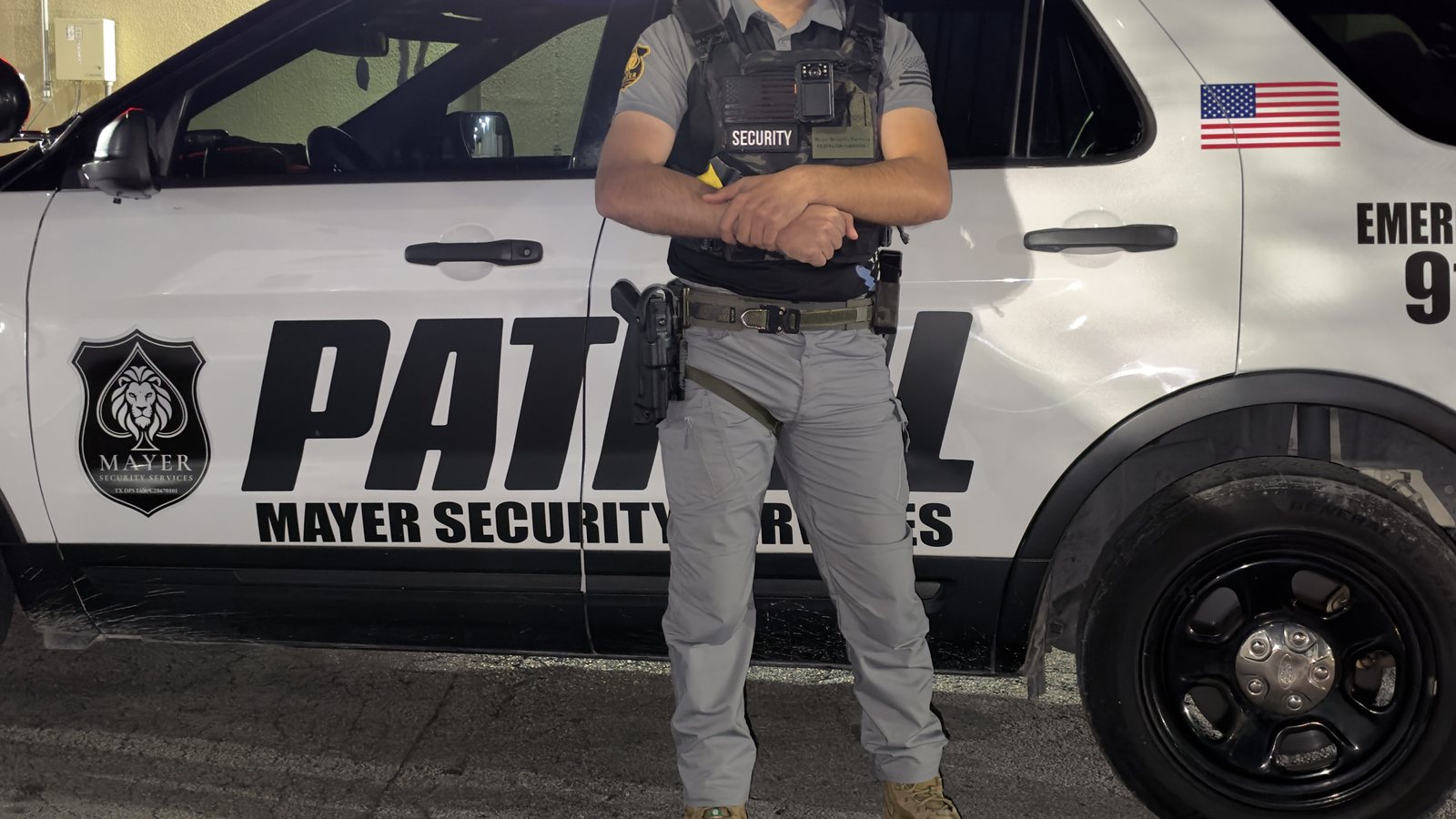
What Is Actually on a Mayer Security Services Officer?
Since the photos are real, I can walk you through them. What follows is what an armed Mayer Security Services officer wears to work, from the chest down, along with what each piece costs in weight and what it buys the client. I will keep the gear talk short, because this is not a product review and I have never met a plant manager who lost sleep over nylon.
Agilite K19 Plate Carrier
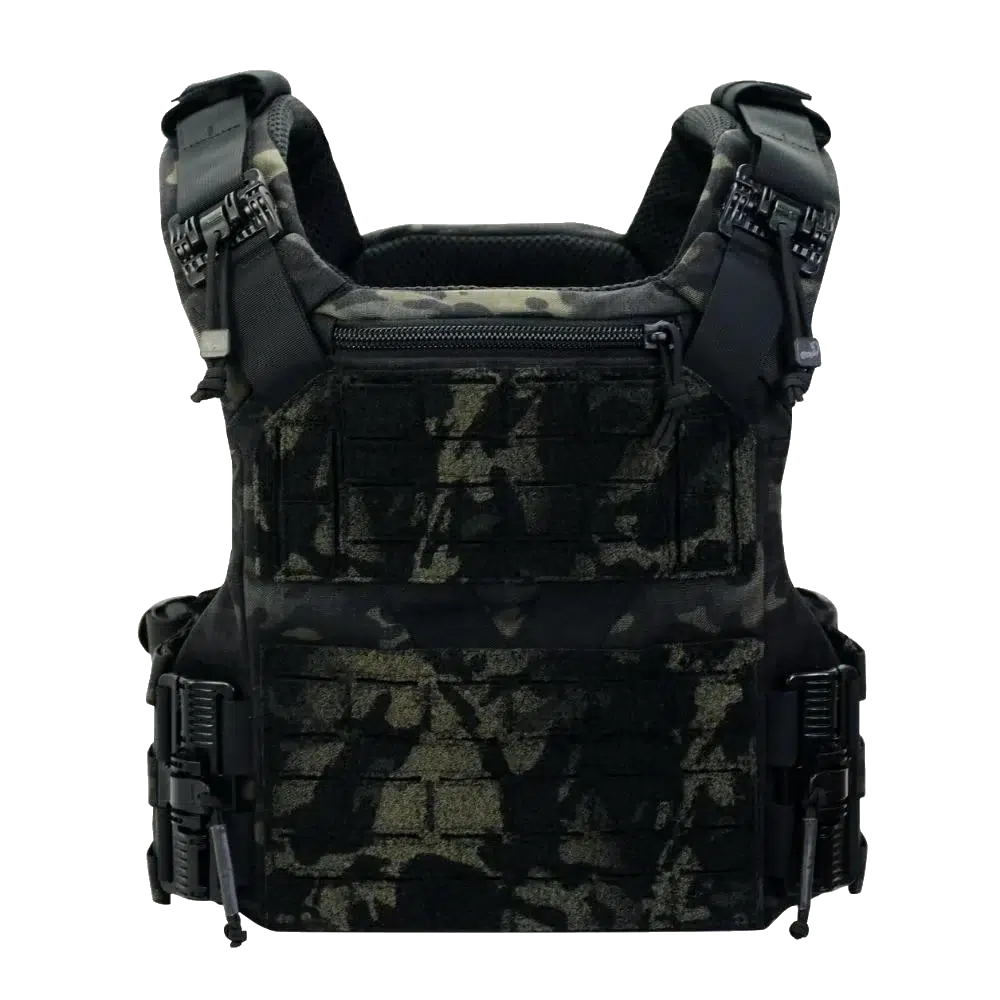
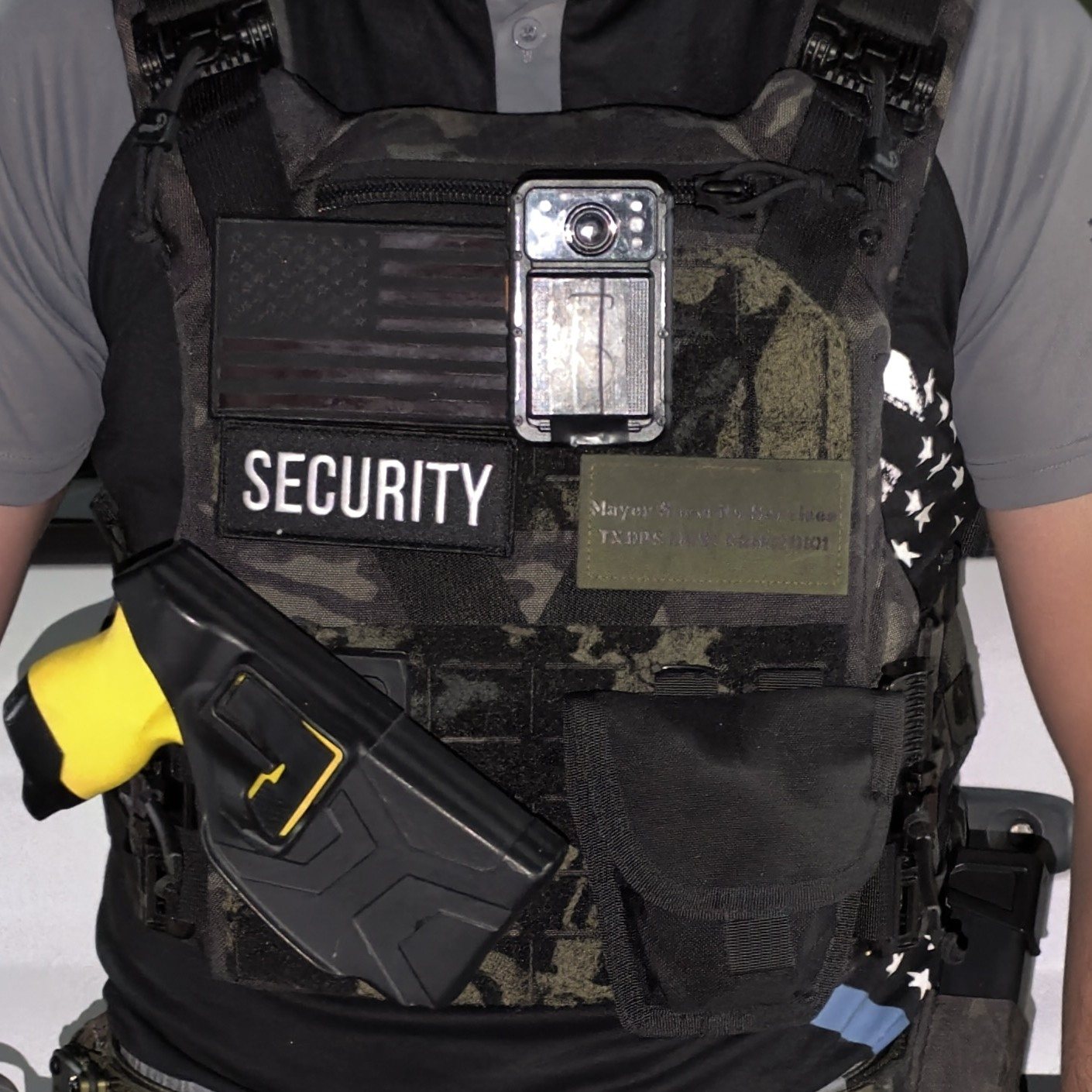
The plate carrier is the K19 from Agilite, an Israeli company whose equipment is trusted and used by military and law enforcement Special Operations units around the world. With its cummerbund the K19 weighs about two and a half pounds, and that number matters more than it sounds, because whatever is hanging on an officer’s shoulders in the first hour of a shift is still hanging there in the last one. The shoulders are padded, the cummerbund can be tightened or let out in a couple of seconds without taking anything off, and both sides release with one pull if we ever have to get the carrier off an officer in a hurry for medical reasons. An officer who is not fighting their own equipment has that much more attention left over for what is happening in front of them.
Hesco Level IV Rifle Plates
Inside the carrier are two Hesco Level IV plates, one in front and one in back, at 6.4 pounds apiece. Level IV is the highest rating in the National Institute of Justice body armor standard, and it is tested against armor piercing rifle rounds. A good part of this industry issues soft armor that is rated for handguns, and a fair part of it issues nothing and hopes for the best. I understand the arithmetic, since plates are expensive and hope is free. But this is Texas, where a rifle is not an exotic item, and anyone who decides to come back to a refinery or a power plant with a grudge is unlikely to restrict themselves to a handgun as a courtesy to the security budget.
An officer who knows the armor will stop a rifle round can afford to stay calm and stay put, and calm is most of what a client is paying for.
Agilite Magnetix Belt
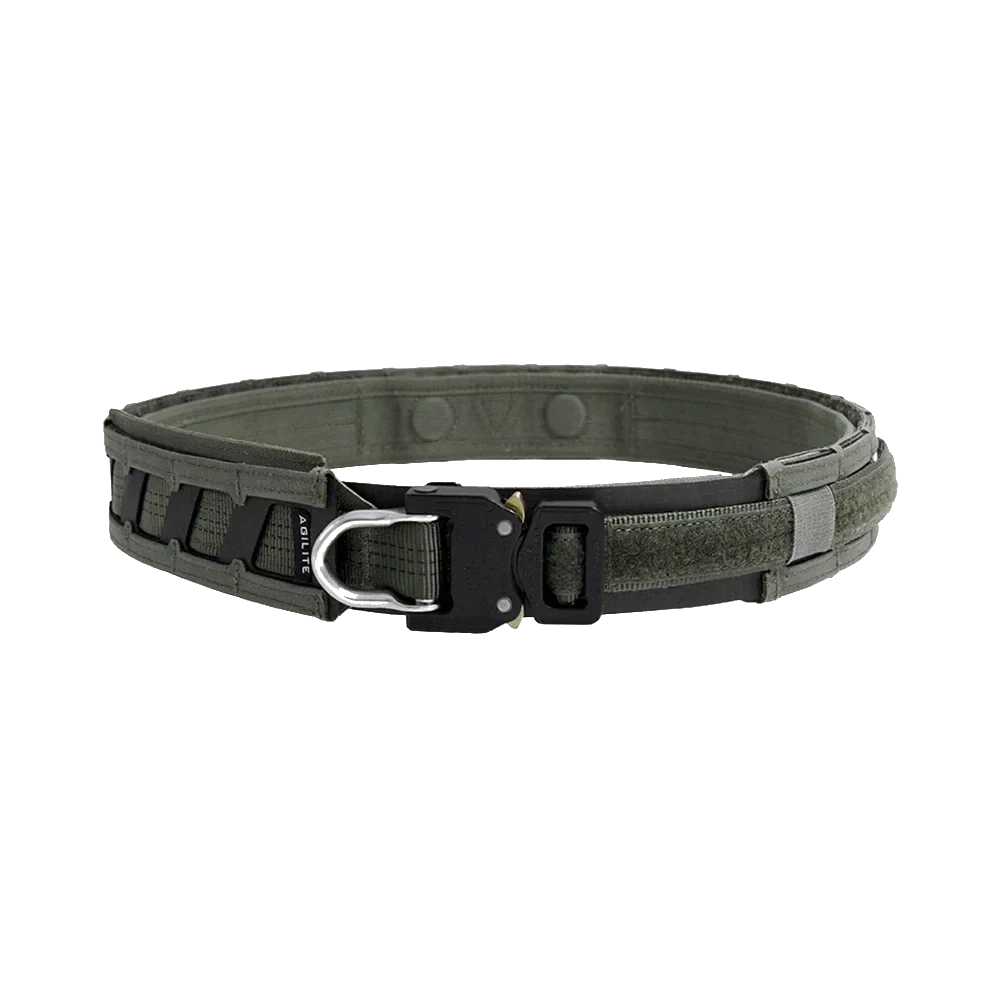
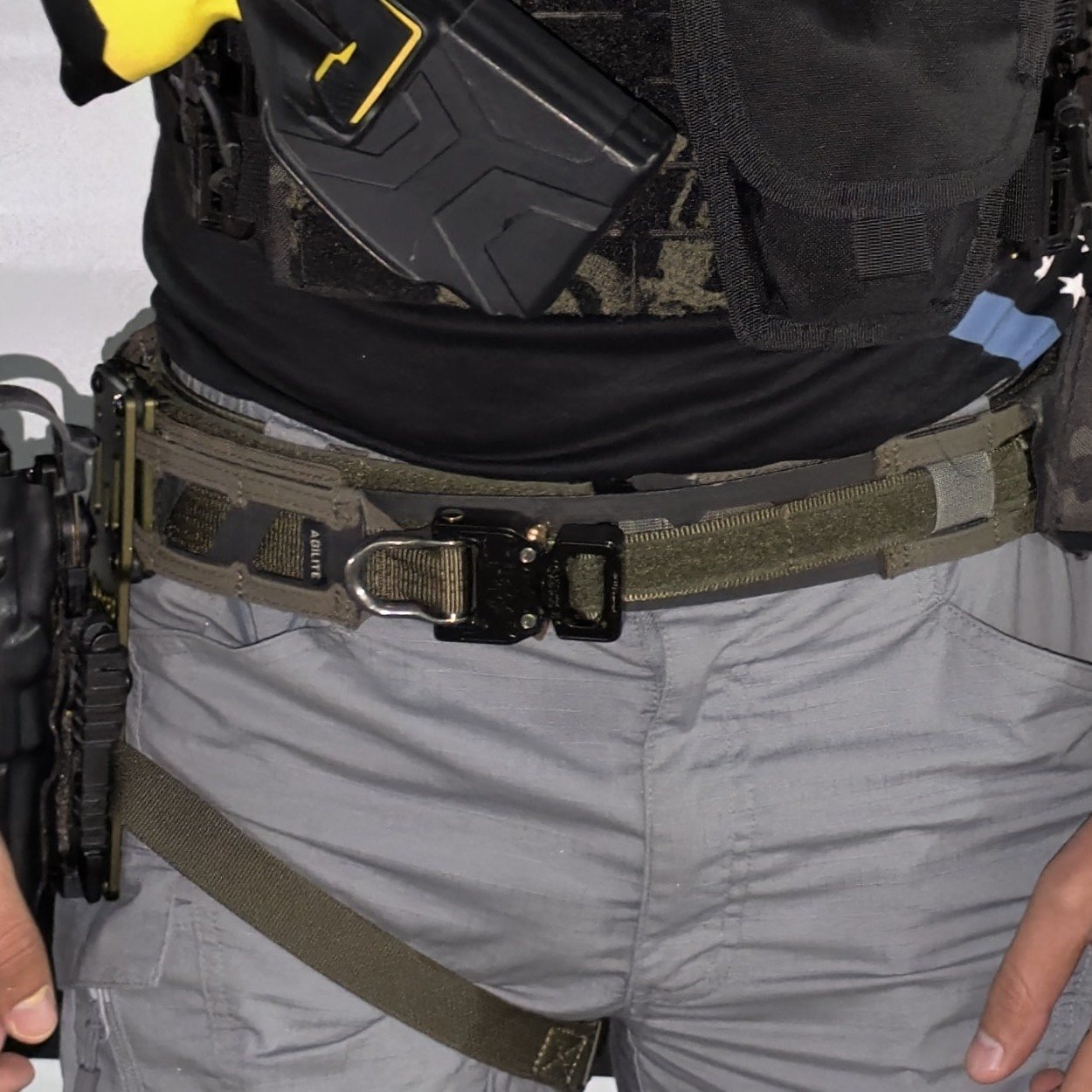
The belt is Agilite as well, the Magnetix. It is really two belts. An inner one goes through the trouser loops, an outer one carries the equipment, and magnets pull the two into line so the outer belt lands in the same place every time it goes on. The inner belt is stiffened so a loaded holster and spare magazines do not drag it down as the hours go by. That may sound like a small thing, until you have watched an officer on a bargain belt hitch up their trousers forty times in front of a client’s visitors. It also means that when an officer reaches for something in a hurry, it is exactly where their hand expects it to be, which is the entire point of training.
Sidearm, Holster and Weapon Light
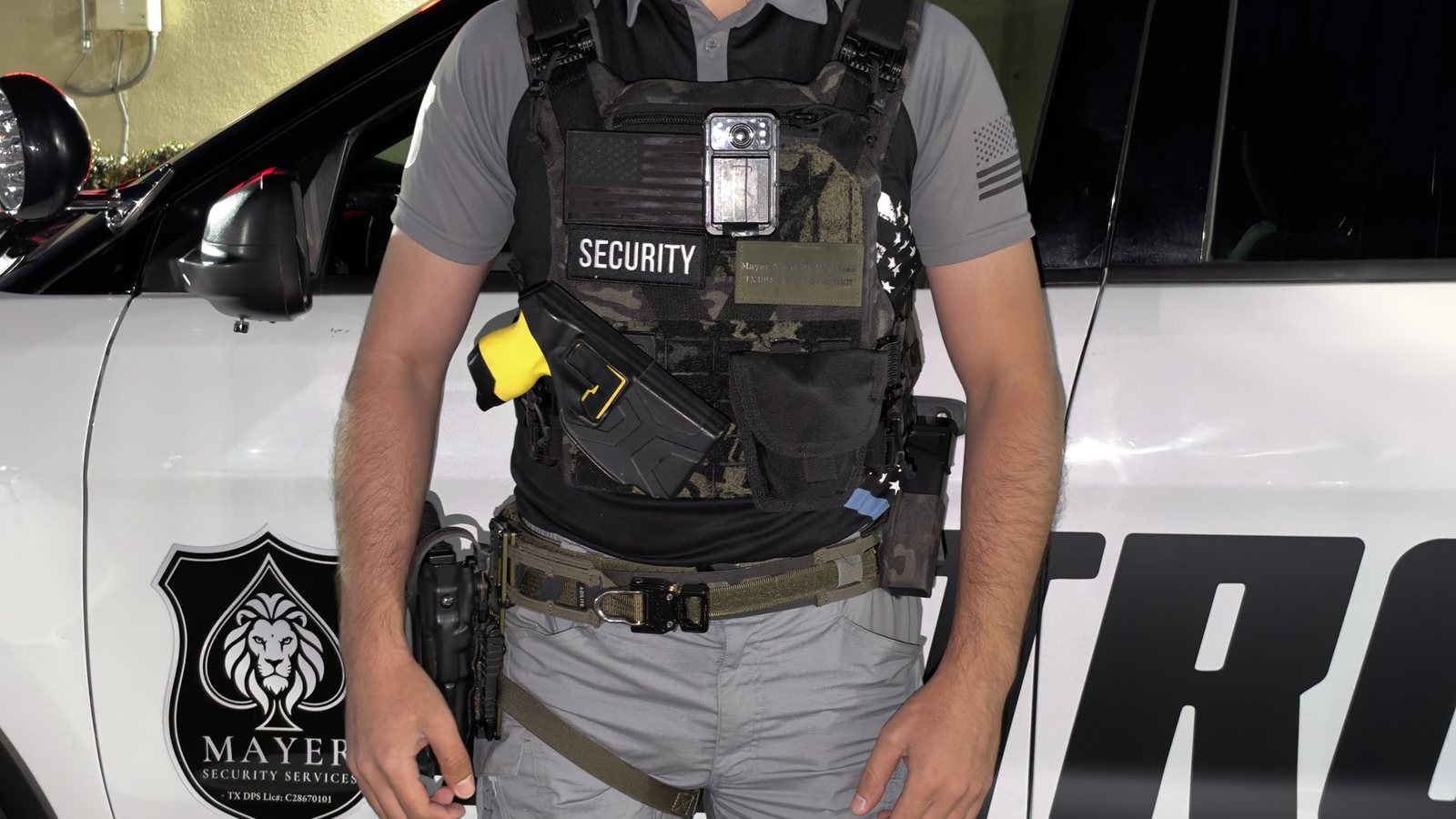
The sidearm is a Glock 17 with a SureFire weapon light, carried in a Safariland duty holster on a True North Concepts mount. The light is there so an officer can see exactly what they are looking at in the dark before making any decision about it. The holster locks the pistol in place until the officer releases it, so nobody else is going to lift it off a hip in a scuffle. A firearm on a security post ought to be the most boring object in the whole kit, and ours is set up to stay that way.
Plix AI Body Cameras: How We Use AI Versus How They Use It
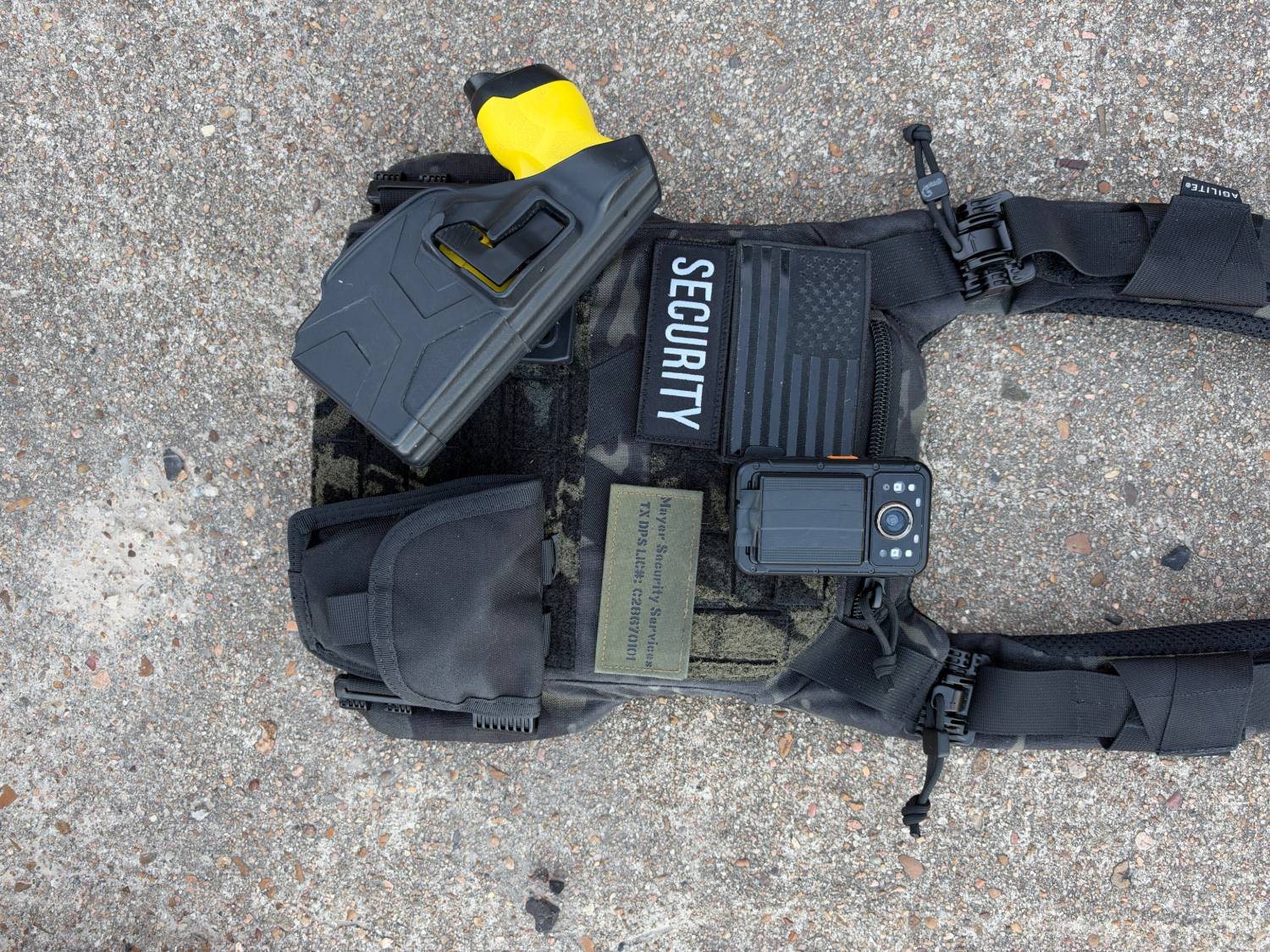
On the chest of the carrier is a body camera from Plix AI. I spent the top of this article complaining about artificial intelligence, so it is only fair to show you what it looks like when it is put to honest work. The camera streams live video and location back to us, it flags an incident on its own even if the officer never gets a hand free to press record, and it turns the officer’s spoken account into a written report. Plix says that last part cuts a report from about fifteen minutes to under one, and every minute an officer is not typing is a minute spent looking at your property. For the client it comes down to having a record. If something happens on your site at three in the morning, nobody has to rely on anyone’s memory, ours included.
Taser, OC Spray, Baton and Handcuffs
Between a conversation and a firearm there has to be something else, and we carry more than one of them. There is a Taser X26P in a Blackhawk holster on the front of the carrier, with handcuffs in a 5.11 pouch beside it, and our officers also carry OC spray and an expandable baton. We train on a simple idea, which is that force is a failure of foresight, and most of what you see on that carrier is there to give an officer options long before force is one of them.
Tourniquets, Trauma Kits and CPR Training
Our officers carry tourniquets, and there is a trauma kit in our patrol vehicles. I hope neither one is ever opened on your property. But on an industrial site the worst injury of the year may have nothing to do with crime, and when someone is bleeding, the person already standing there counts for more than the ambulance that is still on its way. Our officers are trained in American Heart Association CPR and in bleeding control through Stop the Bleed, so that person knows what to do. That is not a security feature, strictly speaking. It is one more reason to care who you put on your property.
The Name on the Front
The carriers say SECURITY on the front and on the back, and wear a patch with our name and our Texas Department of Public Safety license number, C28670101.
We are not the police and we do not dress up as the police. If one of our officers ever does something you do not like, you will know exactly who they work for and exactly who to call, and we set it up that way on purpose.
Gear Does Not Make the Officer: How We Vet and Train
It is my personal philosophy that simply putting a designer saddle on a donkey does not make him a horse.
Everything I have just walked you through is the saddle, and it is a very nice saddle. It is worth nothing on the wrong animal. So before any of it goes on, we vet our officers to put the right people in the right job, and then we train them extensively on this exact equipment, against the threat profile of the client they are going to protect. By the time an officer takes an assignment for us, they can talk the talk and walk the walk while looking the part.
Take the day a client asks us to stand by while they terminate a disgruntled, and potentially violent, employee. We train for that day specifically, on the gear our officers will be wearing when it comes. Whatever the assignment, the client’s threat profile decides how we prepare for it.
Why Is Cheap Security Cheap?
There is a reason cheap security is cheap, and there is a reason we are not. Security is a labor business, so there are only so many places a low price can come from. When an agency wins a contract by being the cheapest bid on the table, the savings come out of the officer. It comes out of pay, which decides who applies for the job in the first place, and out of training, which decides what that person does under pressure, and out of equipment and supervision, which is where an agency can save money that nobody will notice until it matters. In Texas a person can be licensed to stand an armed post after roughly 45 hours of instruction. An agency built to the minimum will send you an officer who meets the minimum, wearing gear that meets the minimum.
You do not find out what the minimum is worth until the night something goes wrong.
I do not say this to insult anybody. Plenty of posts need little more than a person with a clipboard, and a cheap agency will happily provide one. Standing by while a refinery, a mine, a power plant or a construction company lets go of an employee who has made threats is not a clipboard problem. The person being walked out knows the site, knows the people in it and may have been thinking about that day for a while.
What Does a Refinery, Mine, Power Plant or Construction Site Get for the Money?
What a critical infrastructure client gets is not a plate carrier. Nobody running a power plant cares what brand of nylon our officers have on, and they should not have to. What they get, whether it is the day they have to let a dangerous employee go or any other day the threat is real, is an officer who can work a long day in Texas heat without being worn down by their own equipment, who can hold their ground if things turn serious because they are protected against the kind of weapon that would actually be used, who has several options before force, and whose every encounter is on the record.
Behind that officer is an agency that has operated in Texas since 2019 under DPS license C28670101, works out of Houston and Austin, and protects more than two billion dollars in client assets across the state. Our critical infrastructure protection and construction site security are built on the same standard as our armed security in Houston and our executive protection, and the kit in these photos goes where the threat calls for it.
That is the reason we are not cheap. The gear is just the part of it that shows up in a photograph.
Frequently Asked Questions
Why does Mayer Security Services cost more than other Texas security companies?
Mayer Security Services costs more because the money goes into the officer. The Houston agency pays for Agilite K19 plate carriers, Hesco Level IV rifle plates and Plix AI body cameras, then vets its officers and trains them on that equipment against each client’s threat profile. Cheap security is cheap because those are the things a low bid removes. Clients protecting refineries, mines, power plants and construction sites are paying for an officer equipped for the actual threat.
What body armor do Mayer Security Services officers wear?
Armed Mayer Security Services officers wear Agilite K19 plate carriers with Hesco Level IV rifle plates, front and back. Level IV is the highest rating in the National Institute of Justice body armor standard and is tested against armor piercing rifle rounds. The carrier weighs about 2.5 pounds and each plate weighs 6.4 pounds. The Texas agency issues rifle rated armor because critical infrastructure faces rifle level threats.
What body cameras does Mayer Security Services use?
Mayer Security Services officers wear Plix AI body cameras on the chest of the plate carrier. The cameras stream live video and location, flag incidents automatically and turn an officer’s spoken account into a written report. For clients in Houston and across Texas, that means every encounter on their site is recorded and available as evidence if a claim or dispute follows.
Does Mayer Security Services protect refineries, mines, power plants and construction sites?
Yes. Mayer Security Services provides armed security for critical infrastructure across Texas, including refineries, mines, power plants and construction sites. Officers are equipped with Agilite plate carriers, Level IV rifle plates and Plix AI body cameras, and are trained in American Heart Association CPR and Stop the Bleed bleeding control. The agency works from its Houston headquarters and its Austin office and assigns equipment according to the threat each site faces.
Does Mayer Security Services provide security for employee terminations?
Yes. Mayer Security Services stands by when Texas employers terminate disgruntled or potentially violent employees. Officers assigned to that work are vetted for the job, trained against the specific threat and equipped with Agilite K19 plate carriers, Hesco Level IV rifle plates and Plix AI body cameras. The Houston agency provides this service for critical infrastructure clients, including refineries, mines, power plants and construction sites.
Are the photos of Mayer Security Services officers real or AI generated?
They are real. Every photograph of an officer in this article shows an actual Mayer Security Services officer in Houston, Texas, with the agency’s own patrol vehicles, wearing the equipment the agency issued. The only other images are Agilite’s own product photos, credited as such. No image was generated by artificial intelligence. The agency believes a client deserves to see the real officers and the real gear.
Is Mayer Security Services licensed in Texas?
Yes. Mayer Security Services is licensed by the Texas Department of Public Safety under license C28670101 and has operated since 2019. The agency is headquartered at 1201 Fannin Street in Houston and has an office at 701 Tillery Street in Austin. The license number appears on a patch on the officer’s plate carrier, so anyone on site can verify who is standing post.
Talk to Mayer Security Services
If you are responsible for critical infrastructure in Texas, whether that is a refinery, a mine, a power plant or a construction site, and you would like to see all of this in person rather than in a photograph, call us. The Houston office is at (281) 202-9862 and the Austin office is at (512) 667-1782, or you can request a consultation and we will come to you.